| Article number: |
PL3600218 |
| Availability: |
More on the Way to us |
| Delivery time: |
More on the Way to Us |
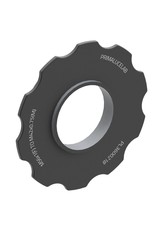
This adapter from PrimaLuceLab allows you to connect any camera or accessory with a T2 (M42×0.75) female thread to the draw tube of the PrimaLuceLab ESATTO 2″ focuser (which uses an M56 thread at the draw-tube end). The relevant product code is PL3600218.
In addition to simple adaption of thread form, the adapter includes a stop-ring feature that lets you fix the camera (or accessory) at a precise rotational angle—useful for framing your sensor or aligning guides/ports etc.
Key Specifications & Features
- Threads: M56 male (to match ESATTO 2″ draw tube) → T2 female (M42 × 0.75) on the camera/accessory side.
- Optical thickness: Quoted at about 4 mm total (1.5 mm for the adapter body + 2.5 mm for the stop ring) when installed.
- The stop ring enables precise rotational alignment of the accessory/camera. This is particularly helpful when using large format sensors, OAGs, filter wheels, or when framing for astrophotography.
- Compatible with ESATTO 2″ (and referenced also the ARCO 2″ rotator in conjunction).
Why This Adapter Is Useful
- Thread conversion: Many astrophotography cameras and accessories use the T2 standard (M42×0.75) for mounting. If your focuser (e.g., an ESATTO 2″) ends in M56, this adapter allows you to bridge the mechanical/optical interface cleanly.
- Minimal optical path: With only ~4 mm thickness added, this adapter helps keep your back-focus margin tight, which is important especially for fast telescopes or imaging trains with limited back-focus.
- Precise rotational alignment: The stop ring means you can orient the camera (or accessory) to a desired rotational angle and lock it in. That’s very helpful when you have off-axis guiders, filter wheels, cable routing, or wish to align the sensor’s frame with the celestial coordinate system.
- Integration with advanced systems: Since you already use advanced gear (you mentioned telescopes, multiple cameras etc), it’s likely you’ll want robust adapters that maintain alignment, low flex, and keep optical path length optimized. This fits well.